Tuesday, November 3, 2015
Nuage Networks and Citrix Collaborate for Application Delivery with SDN and OpenStack
The application landscape is changing. Enterprise organizations are deploying complex scale-out applications.
These applications have many components that have to work together. An application architecture can include a legacy component that resides on a mainframe, it can have services-oriented architecture components, and there can be new micro services that perform specialized tasks.
The network infrastructure is changing in response.
Most applications run on a virtual server infrastructure. Network services are being migrated to virtualized network infrastructure. Network services now exist as virtual appliances. Everything needs to interact, from the application components to the virtual network services.
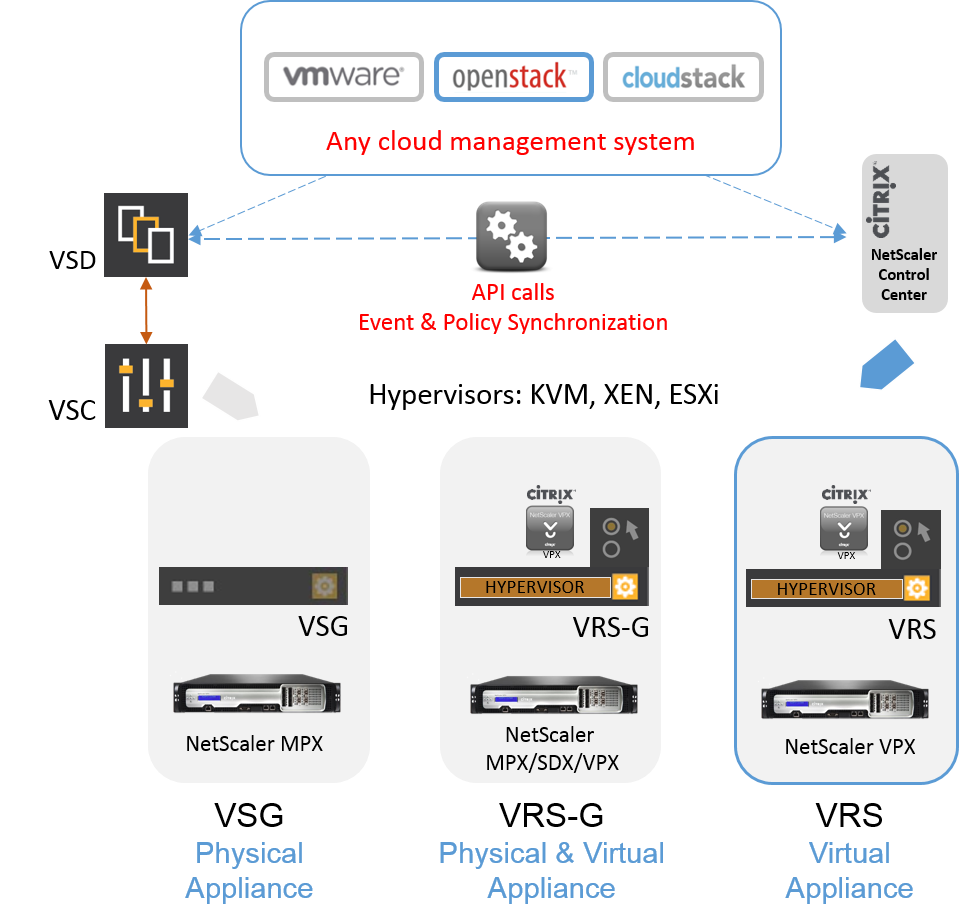
To connect the components, virtual networks like the Nuage Networks Virtualized Services Platform (VSP) have been developed and organizations are using these to connect the pieces of the virtualized applications and the virtualized network components together.


Monday, November 2, 2015
Red Hat OpenStack & Citrix NetScaler Simplify Deployment of L4-L7 Services
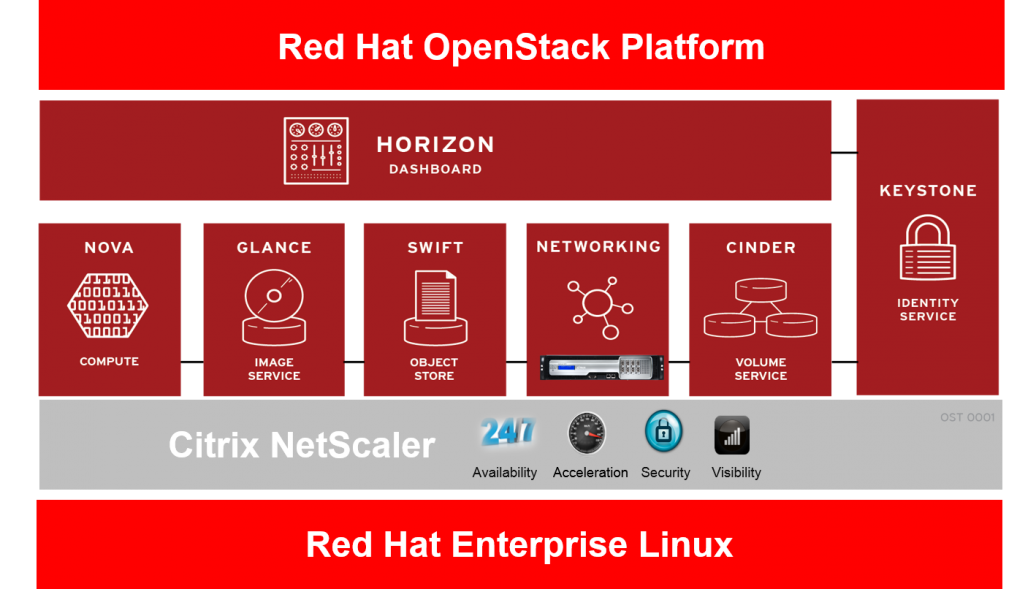
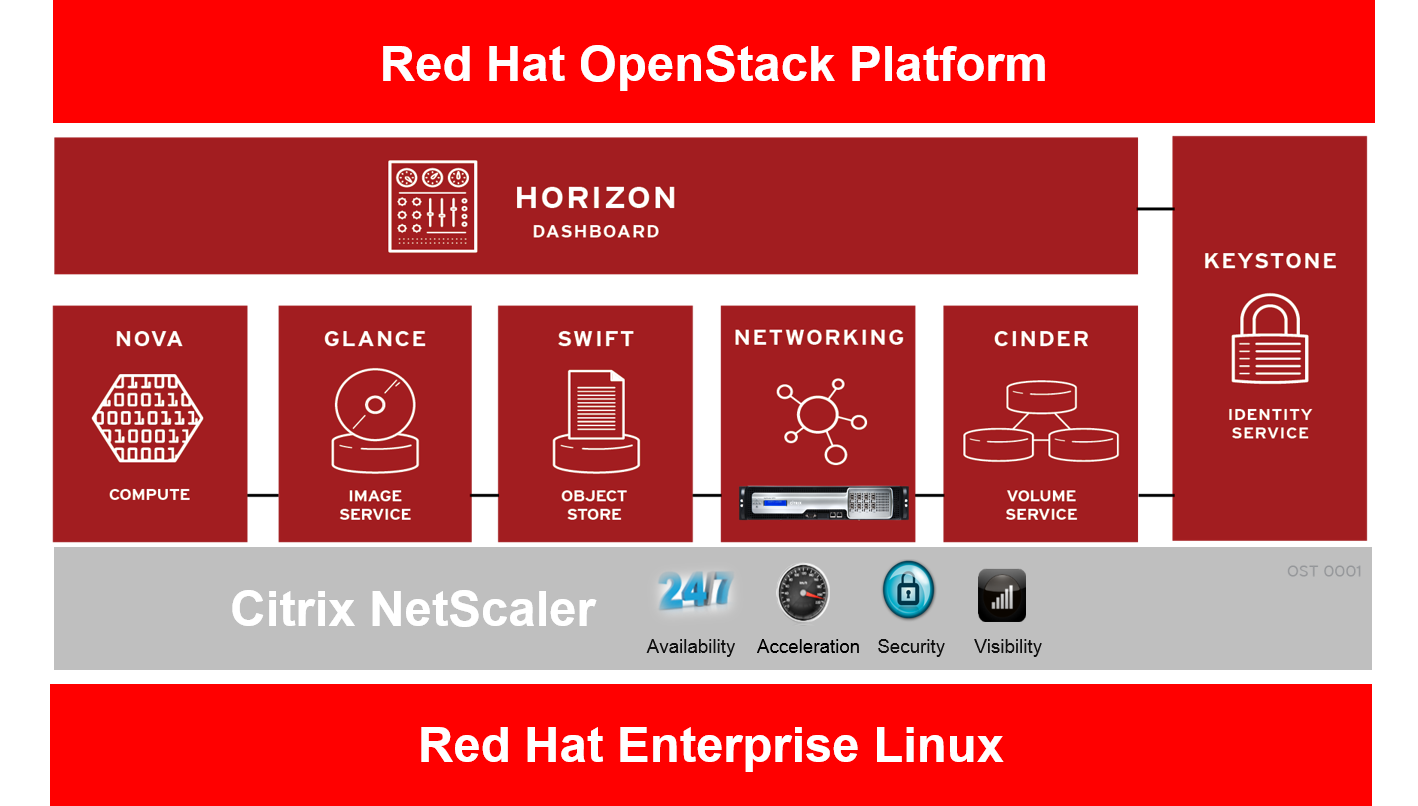
To give customers the ability to automate application delivery network services from OpenStack, Citrix has worked with Red Hat to integrate NetScaler with their OpenStack distribution.
Many organizations are building private cloud platforms as a way to increase the agility of IT infrastructure and to increase the efficiency of operations to support their business critical applications. Over the past few years we have seen an increasing move towards deploying OpenStack, which is an open source cloud management platform, in production environments. By integrating with Red Hat OpenStack, Citrix makes NetScaler available to the many organizations that use this popular OpenStack distribution. As organizations use OpenStack to automate the deployment of servers, storage and networking they are also looking to automate the provisioning of L4 – L7 services. To do this they need their networking equipment vendors to provide integration of their devices with OpenStack in a way that addresses deployment challenges involved in offering infrastructure-as-a-service. These challenges include scalability, elasticity, performance and flexibility/control over resource allocation. Citrix built NetScaler Control Center as a way to ease integration of NetScaler with the LBaaS service in OpenStack. The Citrix LBaaS solution enables IT organizations to guarantee performance and availability service level assurances (SLAs) as well as provide redundancy and seamless elasticity while rapidly deploying line of business applications in OpenSack.
Many organizations are building private cloud platforms as a way to increase the agility of IT infrastructure and to increase the efficiency of operations to support their business critical applications. Over the past few years we have seen an increasing move towards deploying OpenStack, which is an open source cloud management platform, in production environments. By integrating with Red Hat OpenStack, Citrix makes NetScaler available to the many organizations that use this popular OpenStack distribution. As organizations use OpenStack to automate the deployment of servers, storage and networking they are also looking to automate the provisioning of L4 – L7 services. To do this they need their networking equipment vendors to provide integration of their devices with OpenStack in a way that addresses deployment challenges involved in offering infrastructure-as-a-service. These challenges include scalability, elasticity, performance and flexibility/control over resource allocation. Citrix built NetScaler Control Center as a way to ease integration of NetScaler with the LBaaS service in OpenStack. The Citrix LBaaS solution enables IT organizations to guarantee performance and availability service level assurances (SLAs) as well as provide redundancy and seamless elasticity while rapidly deploying line of business applications in OpenSack.
Wednesday, July 8, 2015
Automate Management of NetScaler with Puppet Labs
These days, operations teams are expected to manage increasingly complex infrastructure while meeting business expectations for application delivery.
DevOps practices can be used to enable operations teams to scale servers and applications rapidly and efficiently without time consuming manual configuration. Extending DevOps functionality to the Application Delivery Controller is critical and needs to be a part of any full-featured DevOps software package.

The world is increasingly moving to a model where infrastructure is managed, deployed and scaled as code. NetScaler has been designed to ensure the best APIs and interfaces, fully accessible to the best modern infrastructure management tools out there.
Puppet Labs has been at the forefront of this movement, and we are seeing an increase in our customers that want to integrate and deploy NetScaler as part of their DevOps processes.
This functionality let’s operations teams deploy, automate, and manage the configuration of an entire application infrastructure “stack” including compute, network and storage. This gives application developers the ability to elastically expand and contract infrastructure resources, automate application tests, and reduce application development time frames.
DevOps practices can be used to enable operations teams to scale servers and applications rapidly and efficiently without time consuming manual configuration. Extending DevOps functionality to the Application Delivery Controller is critical and needs to be a part of any full-featured DevOps software package.
The world is increasingly moving to a model where infrastructure is managed, deployed and scaled as code. NetScaler has been designed to ensure the best APIs and interfaces, fully accessible to the best modern infrastructure management tools out there.
Puppet Labs has been at the forefront of this movement, and we are seeing an increase in our customers that want to integrate and deploy NetScaler as part of their DevOps processes.
The Puppet Enterprise Module for NetScaler
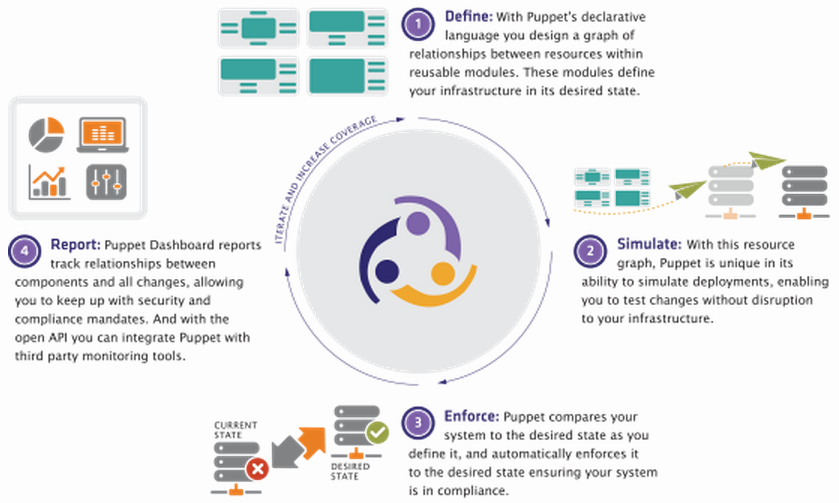
The Citrix NetScaler team and the Puppet Labs module team are happy to announce the availability of the Puppet Enterprise-supported Citrix NetScaler module. This module lets you manage NetScaler physical and virtual appliances. Puppet unifies tooling and processes that used to be siloed, giving you all the benefits of managing your infrastructure as code. With its declarative, model-based approach to IT automation, the Puppet Enterprise solution enables you to perform functions as diverse as automating simple, repetitive tasks to deploying large-scale public, private, and hybrid clouds.
This functionality let’s operations teams deploy, automate, and manage the configuration of an entire application infrastructure “stack” including compute, network and storage. This gives application developers the ability to elastically expand and contract infrastructure resources, automate application tests, and reduce application development time frames.
Wednesday, July 1, 2015
A Practical Path to Automating Application Delivery Networks
The ongoing virtualization of data center infrastructure and integration of cloud computing resources makes it possible to be able to dynamically shift and monitor workloads across those environments.
As data center networks have grown to encompass thousands of devices, existing network architectures have proven inadequate for rapid deployment of applications and unable to keep up with the agility requirements of today’s business environment.
Software Defined Networking (SDN) has been promoted as the solution for dynamically provisioning and automatically configuring network resources as applications are deployed. Recently SDN has moved beyond theory to practical reality, as open standards and growing interoperability among vendors are driving rollouts of new capabilities.
Evolving to an Application Centric Infrastructure
With ACI Cisco envisions a distributed, policy driven approach to SDN that relies on the concept of declarative control. “Declarative control dictates that each object is asked to achieve a desired state and makes a promise to reach this state, without being told precisely how to do so,” according to Cisco. As a result, “underlying objects handle their own configuration state changes and are responsible only for passing exceptions or faults back to the control system. This approach reduces the burden and complexity of the control system and allows greater scale.”
As data center networks have grown to encompass thousands of devices, existing network architectures have proven inadequate for rapid deployment of applications and unable to keep up with the agility requirements of today’s business environment.
Software Defined Networking (SDN) has been promoted as the solution for dynamically provisioning and automatically configuring network resources as applications are deployed. Recently SDN has moved beyond theory to practical reality, as open standards and growing interoperability among vendors are driving rollouts of new capabilities.
Evolving to an Application Centric Infrastructure
With ACI Cisco envisions a distributed, policy driven approach to SDN that relies on the concept of declarative control. “Declarative control dictates that each object is asked to achieve a desired state and makes a promise to reach this state, without being told precisely how to do so,” according to Cisco. As a result, “underlying objects handle their own configuration state changes and are responsible only for passing exceptions or faults back to the control system. This approach reduces the burden and complexity of the control system and allows greater scale.”
Thursday, June 4, 2015
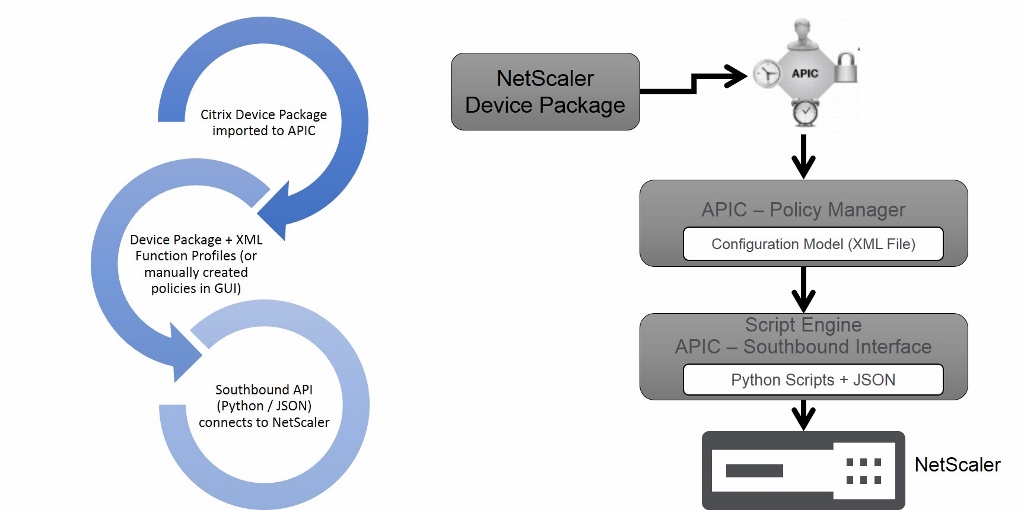
Citrix NetScaler and Cisco ACI: How it all Works
It’s an exciting week ahead at Cisco Live in San Diego.
Citrix is pleased to be a key Cisco ACI ecosystem partner through the integration of the Citrix NetScaler ADC with the Cisco APIC controller.
There are several interesting technologies being leveraged to deliver this joint solution and I thought would be interesting to take a look at how it is implemented. Cisco APIC addresses the two main requirements for achieving the application centric data center vision:
•Policy-based automation framework
•Policy-based service insertion technology
A policy-based automation framework enables the APIC to dynamically provision and configure resources according to application requirements.
As a result, core services such as firewalls and Layer 4 through 7 switches can be consumed by applications and made ready to use in a single automated step.
Being application-centric, the APIC allows the creation of application profiles, which define the Layer 4 through 7 services consumed by a given data center tenant application. As a key ADC partner in the ACI ecosystem, Citrix NetScaler provides L4-L7 services such as load balancing, application acceleration, and application security.
Cisco ACI and Citrix NetScaler ADC Solution

Figure 1. Cisco ACI and Citrix NetScaler ADC Solution
Citrix is pleased to be a key Cisco ACI ecosystem partner through the integration of the Citrix NetScaler ADC with the Cisco APIC controller.
There are several interesting technologies being leveraged to deliver this joint solution and I thought would be interesting to take a look at how it is implemented. Cisco APIC addresses the two main requirements for achieving the application centric data center vision:
•Policy-based automation framework
•Policy-based service insertion technology
A policy-based automation framework enables the APIC to dynamically provision and configure resources according to application requirements.
As a result, core services such as firewalls and Layer 4 through 7 switches can be consumed by applications and made ready to use in a single automated step.
Being application-centric, the APIC allows the creation of application profiles, which define the Layer 4 through 7 services consumed by a given data center tenant application. As a key ADC partner in the ACI ecosystem, Citrix NetScaler provides L4-L7 services such as load balancing, application acceleration, and application security.
Cisco ACI and Citrix NetScaler ADC Solution

Figure 1. Cisco ACI and Citrix NetScaler ADC Solution
Tuesday, June 2, 2015
Citrix and Cisco Deliver Application Agility and a Path to Software Defined Networks
Applications are the core of any business. To respond quickly to changing business requirements, IT organizations must be able to deploy applications rapidly across a broad range of physical and virtual infrastructure while ensuring performance, scalability, security and visibility.
But applications are only as agile as the infrastructures on which they run.
With traditional datacenter infrastructure, it can take weeks to make an application change. Cloud, mobility and virtualization trends further complicate the interplay between applications, network services and the underlying infrastructure. Achieving a truly agile, application-driven datacenter requires a flexible infrastructure that can respond dynamically to application needs, automatically provisioning and configuring the necessary resources independent of their location.
Citrix and Cisco Systems have worked to accelerate the transformation to new network service delivery models that provide greater business agility. They deliver a robust set of capabilities--from product integration and validated designs to new technologies--that provide immediate benefits to customers while streamlining the transition to software-defined networks (SDN) and application-centric infrastructure.

But applications are only as agile as the infrastructures on which they run.
With traditional datacenter infrastructure, it can take weeks to make an application change. Cloud, mobility and virtualization trends further complicate the interplay between applications, network services and the underlying infrastructure. Achieving a truly agile, application-driven datacenter requires a flexible infrastructure that can respond dynamically to application needs, automatically provisioning and configuring the necessary resources independent of their location.
Citrix and Cisco Systems have worked to accelerate the transformation to new network service delivery models that provide greater business agility. They deliver a robust set of capabilities--from product integration and validated designs to new technologies--that provide immediate benefits to customers while streamlining the transition to software-defined networks (SDN) and application-centric infrastructure.
Sunday, May 31, 2015
Cisco ACI and Citrix NetScaler Automate Services Provisioning and Increase Application Performance
With Cisco Live coming up in San Diego at Citrix we are ramping up to talk about NetScaler and the integration that we have done with Cisco Application Centric Architecture (ACI). The world’s leading enterprises, service providers, cloud computing platforms, and eight of the top ten internet-centric companies, have standardized on Citrix NetScaler to deliver their business-critical web applications. By integrating with Cisco ACI we are bringing the benefits of the top application delivery controller to the leading software defined network architecture and enabling our customers to automate NetScaler deployments.
Challenges with Application Delivery
As businesses look to IT as a point of strategic differentiation, agility in the datacenter becomes more critical than ever. Fundamental to this change is the capability of IT to respond quickly to changing business requirements. Applications serve as the core of any business, but applications are only as agile as the infrastructure on which they run. With yesterday’s datacenter infrastructure, this can mean waiting weeks for an application change. Application agility, mobility, and rapid deployment require the datacenter infrastructure to dynamically respond to application needs as a result of changing business requirements.

Challenges with Application Delivery
As businesses look to IT as a point of strategic differentiation, agility in the datacenter becomes more critical than ever. Fundamental to this change is the capability of IT to respond quickly to changing business requirements. Applications serve as the core of any business, but applications are only as agile as the infrastructure on which they run. With yesterday’s datacenter infrastructure, this can mean waiting weeks for an application change. Application agility, mobility, and rapid deployment require the datacenter infrastructure to dynamically respond to application needs as a result of changing business requirements.
Thursday, May 28, 2015
Leveraging Multi-tenancy in the ADC as a Way to the Cloud
Over the last few years, organizations have increasingly been shifting their data centers to a cloud-based model. This transition has been built upon virtualization, automation and orchestration of IT resources—mainly server, storage and switching infrastructure. The goal is to increase agility and reduce the costs of deploying and managing resources to support business applications.
As the transition to cloud-based data centers marches on, it is becoming apparent that organizations need to keep going after they virtualize their server, storage and switching infrastructures. To maximize device consolidation and increase flexibility and agility in deploying resources, other components instrumental to the security, performance and availability of the organization’s computing services need to take part in the transformation.
While increasing agility and reducing costs are worthwhile goals, there are additional concerns when it comes to supporting applications. In its report, “Cloud Service Strategies: North American Enterprise Survey, January 15, 2014,” Infonetics Research found that 79 percent of respondents want to improve application performance, 78 percent want to respond more quickly to business needs, 77 percent want to speed up application deployment and increase scalability, and 73 percent expect to reduce costs with cloud services.

As the transition to cloud-based data centers marches on, it is becoming apparent that organizations need to keep going after they virtualize their server, storage and switching infrastructures. To maximize device consolidation and increase flexibility and agility in deploying resources, other components instrumental to the security, performance and availability of the organization’s computing services need to take part in the transformation.
While increasing agility and reducing costs are worthwhile goals, there are additional concerns when it comes to supporting applications. In its report, “Cloud Service Strategies: North American Enterprise Survey, January 15, 2014,” Infonetics Research found that 79 percent of respondents want to improve application performance, 78 percent want to respond more quickly to business needs, 77 percent want to speed up application deployment and increase scalability, and 73 percent expect to reduce costs with cloud services.
Wednesday, May 27, 2015
Citrix NetScaler VPX on Microsoft Azure Accelerates Your Applications in the Cloud
Cloud computing offers a fundamental change in the way organizations deploy and accesses their business applications. Cloud computing is about leveraging resources over the network to enable an organization to work more efficiently and with greater agility. Getting the best results from applications in the cloud requires an application delivery controller (ADC) to provide an always-on, always-secure foundation to ensure performance. The ADC solution for the cloud needs to provide the ability to balance workloads and manage user traffic while providing granular visibility into application performance and control for reliable application delivery. To meet these needs Citrix and Microsoft have collaborated to make the Citrix NetScaler ADC available on Microsoft Azure.
Citrix NetScaler VPX for Microsoft Azure
Citrix NetScaler VPX is a virtual appliance for L4-7 networking services that ensures organizations have access to applications deployed in the cloud that is secure and optimized for high performance. VPX supports widely deployed applications such as Citrix XenApp® and Citrix XenDesktop®, as well as specific workloads including Microsoft Exchange, SQL, and SharePoint. VPX provides a networking foundation that ensures scalability, adjusting to the changing needs of a cloud environment without the physical limitations. A superior user experience on Microsoft applications and workloads is delivered through performance enhancements such as compressing, load balancing, and SSL acceleration. VPX provides a set of capabilities to ensure availability and to keep applications connected and protected. Advanced security capabilities ensure against attacks that can disable your applications or put your data in danger. VPX allows organizations to securely connect to their environments from anywhere from any device. VPX puts you in control of applications with the visibility required to keep your applications performing.

NetScaler routes traffic in and out of the Azure Virtual Network with two or more subnets within each virtual network. Customers can leverage Network Security Groups to control network traffic by providing a filter for each VM within a subnet. Each virtual network has a single NetScaler VPX deployed across it.
Citrix NetScaler VPX for Microsoft Azure
Citrix NetScaler VPX is a virtual appliance for L4-7 networking services that ensures organizations have access to applications deployed in the cloud that is secure and optimized for high performance. VPX supports widely deployed applications such as Citrix XenApp® and Citrix XenDesktop®, as well as specific workloads including Microsoft Exchange, SQL, and SharePoint. VPX provides a networking foundation that ensures scalability, adjusting to the changing needs of a cloud environment without the physical limitations. A superior user experience on Microsoft applications and workloads is delivered through performance enhancements such as compressing, load balancing, and SSL acceleration. VPX provides a set of capabilities to ensure availability and to keep applications connected and protected. Advanced security capabilities ensure against attacks that can disable your applications or put your data in danger. VPX allows organizations to securely connect to their environments from anywhere from any device. VPX puts you in control of applications with the visibility required to keep your applications performing.
NetScaler routes traffic in and out of the Azure Virtual Network with two or more subnets within each virtual network. Customers can leverage Network Security Groups to control network traffic by providing a filter for each VM within a subnet. Each virtual network has a single NetScaler VPX deployed across it.
Friday, May 15, 2015
Using Application Delivery Services to Build Scalable OpenStack Clouds
As your organization seeks to increase IT agility and reduce operating costs building an orchestration platform like OpenStack to automate the deployment of resources makes a lot of sense. As you plan the implementation of your OpenStack platform ensuring application availability and performance is a necessary design goal. There are a number of things to consider to this end, for example how do you minimize downtime, or support your legacy applications, as well as your applications that are built for the cloud. You might need to host multiple tenants on your cloud platform, and deliver performance SLAs to them. Larger application deployments might require extending cloud platform services to multiple locations.
To ensure a successful implementation of OpenStack you need design recommendations around best practices for multi-zone and multi-region cloud architectures. There are two major areas to look at. One is resource segregation or ‘pooling’ and the use of cloud platform constructs such as availability zones and host aggregates to group infrastructure into fault domains and high-availability domains. The other is how to use an ADC to provide highly available, highly performant, application delivery and load balancing services in your distributed, multi-tenant, fault-tolerant cloud architecture.
Best Practices for Multi-Zone and Multi-Region Cloud Integration
It’s easier to build resilient and scalable OpenStack data centers if three best-practice rules are applied in planning:
•Segregate physical resources to create fault domains, and plan to mark these as OpenStack Availability Zones.
•Distribute OpenStack and database controllers across three or more adjacent fault domains to create a resilient cluster.
•Networks - Design considerations should include both data plane and control plane networking criteria for scale out and high-availability.
To ensure a successful implementation of OpenStack you need design recommendations around best practices for multi-zone and multi-region cloud architectures. There are two major areas to look at. One is resource segregation or ‘pooling’ and the use of cloud platform constructs such as availability zones and host aggregates to group infrastructure into fault domains and high-availability domains. The other is how to use an ADC to provide highly available, highly performant, application delivery and load balancing services in your distributed, multi-tenant, fault-tolerant cloud architecture.
Best Practices for Multi-Zone and Multi-Region Cloud Integration
It’s easier to build resilient and scalable OpenStack data centers if three best-practice rules are applied in planning:
•Segregate physical resources to create fault domains, and plan to mark these as OpenStack Availability Zones.
•Distribute OpenStack and database controllers across three or more adjacent fault domains to create a resilient cluster.
•Networks - Design considerations should include both data plane and control plane networking criteria for scale out and high-availability.
Thursday, April 2, 2015
Simplify Integration Of L4 - L7 Services With OpenStack and NetScaler
Many organizations are building private cloud platforms as a way to increase the agility of IT infrastructure and to increase the efficiency of operations to support their business critical applications. Over the past few years we have seen an increasing move towards deploying OpenStack, which is an open source cloud management platform, in production environments.
As organizations use OpenStack to automate the deployment of servers, storage and networking, they are also looking to automate the provisioning of L4 – L7 services. To do this, they need their networking equipment vendors to provide integration of their devices with OpenStack in a way that addresses deployment challenges involved in offering infrastructure-as-a-service. These challenges include scalability, elasticity, performance and flexibility/control over resource allocation.
To enable the automated deployment of application delivery services with OpenStack, Citrix has built NetScaler Control Center as a way to integrate with the LBaaS service in OpenStack. The Citrix LBaaS solution enables IT organizations to guarantee performance and availability service level assurances (SLAs) as well as provide redundancy and seamless elasticity while rapidly deploying line of business applications in OpenSack.
As organizations use OpenStack to automate the deployment of servers, storage and networking, they are also looking to automate the provisioning of L4 – L7 services. To do this, they need their networking equipment vendors to provide integration of their devices with OpenStack in a way that addresses deployment challenges involved in offering infrastructure-as-a-service. These challenges include scalability, elasticity, performance and flexibility/control over resource allocation.
To enable the automated deployment of application delivery services with OpenStack, Citrix has built NetScaler Control Center as a way to integrate with the LBaaS service in OpenStack. The Citrix LBaaS solution enables IT organizations to guarantee performance and availability service level assurances (SLAs) as well as provide redundancy and seamless elasticity while rapidly deploying line of business applications in OpenSack.
The Challenge with Resource Deployment
OpenStack has come a long way in simplifying the provisioning of computer, storage and networking resources as part of an application deployment workflow. Neutron, which is the networking project for OpenStack, automates the creation and management of L2/L3 networks, as well as the associated L4/L7 network services such as firewalling, load balancing and VPN services. While Neutron has made rapid advancements in enabling a self-service consumption model for networking, there are still operational gaps that need to be addressed for successfully deploying business critical workloads. Some of these gaps include providing for service-aware resource allocation, resource elasticity on demand, monitoring and visibility, fault tolerance and high availability. It is important that cloud providers have complete control over policies that control these operational characteristics, even in fully automated environments.Saturday, January 31, 2015
A Look Back at 2014 and Innovation at Juniper Networks
As the year comes to an end it’s always interesting to look back at the changes in the industry and the progress that we made as a company in the last year. There were many trends that emerged or took further hold of the industry in 2014. Let’s take a look at them and see how Juniper delivered innovation in these areas. Cloud computing and the need for on-demand resources was a big one. The open source movement is continuing to grow in the cloud space and OpenStack and CloudStack are gaining momentum. The Dev/Ops movement and the need for automation of IT resources was another big trend in the news. We saw Dev/Ops extend to networking equipment like the top of rack switch, when it had previously been mainly for server configuration. Overlay networks took hold in 2014 with the likes of Juniper’s Contrail and VMware’s NSX gaining momentum. New network fabric architectures were introduced like IPClos that is popular with the MSDC’s or Massively Scalable Data Center Operators and Spine and Leaf architectures that offer simplified deployment and management. The rise of the Open Compute Project and its move to include networking was a bit of a surprise for me. There is certainly something going on there.
Openstack/Cloudstack Integration
Cloud computing is transforming the way business is done today. It’s not hard to see why when you consider all the benefits that the cloud promises such as flexibility, business agility and economies of scale. As you look into the underlying layers of compute, storage and network, there is complexity in managing such an infrastructure in a dynamic environment. Organizations that are building clouds need a platform to automate the deployment of infrastructure. In addition to offerings from commercial vendors this type of software stack is being developed by the user community of open source organizations. In the interests of being open and offering our customers choices Juniper announced support for OpenStack back in 2013. We continued this momentum by announcing support for CloudStack in 2014. For more on CloudStack see, CloudStack and Juniper’s MetaFabric, Enabling Private and Public Cloud.
Automation Integration with Puppet, Chef and Ansible
Juniper has always been about being open. We serve a diverse set of customers with different use cases who like to use different tool sets. Back in 2013 we announced support for Puppet. We kept up this momentum by later announcing support for Chef and then for Ansible in 2014. There are sysadmin using Puppet or Chef to manipulate infrastructure as code. Because we are open, we’ve productize the capability to work with these tools into both our hardware and software solutions. Ultimately this gives our customers greater flexibility, without having to do a costly rip and replace of their infrastructure, in choosing which automation tools to use. Of course Juniper has had on the box automation as a part of JUNOS for many years. For more on automation see, Automation with Chef, Puppet and Ansible.
Openstack/Cloudstack Integration
Cloud computing is transforming the way business is done today. It’s not hard to see why when you consider all the benefits that the cloud promises such as flexibility, business agility and economies of scale. As you look into the underlying layers of compute, storage and network, there is complexity in managing such an infrastructure in a dynamic environment. Organizations that are building clouds need a platform to automate the deployment of infrastructure. In addition to offerings from commercial vendors this type of software stack is being developed by the user community of open source organizations. In the interests of being open and offering our customers choices Juniper announced support for OpenStack back in 2013. We continued this momentum by announcing support for CloudStack in 2014. For more on CloudStack see, CloudStack and Juniper’s MetaFabric, Enabling Private and Public Cloud.
Automation Integration with Puppet, Chef and Ansible
Juniper has always been about being open. We serve a diverse set of customers with different use cases who like to use different tool sets. Back in 2013 we announced support for Puppet. We kept up this momentum by later announcing support for Chef and then for Ansible in 2014. There are sysadmin using Puppet or Chef to manipulate infrastructure as code. Because we are open, we’ve productize the capability to work with these tools into both our hardware and software solutions. Ultimately this gives our customers greater flexibility, without having to do a costly rip and replace of their infrastructure, in choosing which automation tools to use. Of course Juniper has had on the box automation as a part of JUNOS for many years. For more on automation see, Automation with Chef, Puppet and Ansible.
Wednesday, September 10, 2014
Making the Transition to an Open SDN Architecture in the Enterprise Private Cloud
Enterprise IT is moving away from acting as siloed service organizations to aligning with the business’ goals to help their organizations enhance their business agility, value and customer experience. Many of these organizations are moving to a cloud computing model to achieve these goals, but they haven’t determined the best strategy for making this transition.
Transitioning to the cloud will help these organizations accelerate innovation and business agility by emphasizing a number of important factors. Adaptability is one. Seamless scale, both upward and downward, is another. Network intelligence that will provide proactive resource optimization is a third.
To make this transition, organizations need the right infrastructure, and they must be prepared to answer questions regarding SDN, orchestration, security, network protocols and many other issues.
These are addressed by two application-aware architectures for the enterprise private cloud:
1. Juniper Networks’ open SDN architecture
2. A proprietary programmable architecture that requires investment in a centralized controller and application-aware switch combination.

Transitioning to the cloud will help these organizations accelerate innovation and business agility by emphasizing a number of important factors. Adaptability is one. Seamless scale, both upward and downward, is another. Network intelligence that will provide proactive resource optimization is a third.
To make this transition, organizations need the right infrastructure, and they must be prepared to answer questions regarding SDN, orchestration, security, network protocols and many other issues.
These are addressed by two application-aware architectures for the enterprise private cloud:
1. Juniper Networks’ open SDN architecture
2. A proprietary programmable architecture that requires investment in a centralized controller and application-aware switch combination.
Wednesday, August 13, 2014
Announcing Juniper's Most Highly-Available Campus Distribution Switch
Recently Juniper Networks announced the EX4600 switch that is built for the distribution layer in campus networks. It is designed for IT networking teams of enterprises and SMBs who are rolling out new applications and services and require higher performance to support them. This compact switch delivers innovations that were developed in the data center including ISSU for hitless upgrades, Insight Technology for performane monitoring and 40GbE ports for high speed uplinks. It works as a standalone switch as well as in Virtual Chassis and MC-LAG architectures as an options providing simplified management and network resiliency.

IT organizations are concerned about having sufficient switching performance to support increasing access to applications in the cloud from the campus. They need to support diverse devices for the current BYOD trend as well as support the demands of services like VDI, the growing use of wireless access and unified communications. As they continue to scale, designing their operations to accommodate increasing volumes of traffic, IT organizations are concerned about managing secure access, connectivity and bandwidth usage. However, despite the increasing and ever changing network usage patterns and the demands of supporting more devices and services IT teams are still expected to make things work with limited staffing resources and budgets. What the IT teams require is an easy-to-manage solution that delivers high-performance connectivity at an affordable price.
“More than three-quarters of the IT organizations we surveyed have either already standardized their campus networks on 10 GbE or are actively planning a move from 1 GbE to 10 GbE. Drivers include bandwidth-intensive applications, current or anticipated traffic levels and falling costs of the technology,” said Bob Laliberte, Senior Analyst, Enterprise Strategy Group.
IT organizations are concerned about having sufficient switching performance to support increasing access to applications in the cloud from the campus. They need to support diverse devices for the current BYOD trend as well as support the demands of services like VDI, the growing use of wireless access and unified communications. As they continue to scale, designing their operations to accommodate increasing volumes of traffic, IT organizations are concerned about managing secure access, connectivity and bandwidth usage. However, despite the increasing and ever changing network usage patterns and the demands of supporting more devices and services IT teams are still expected to make things work with limited staffing resources and budgets. What the IT teams require is an easy-to-manage solution that delivers high-performance connectivity at an affordable price.
“More than three-quarters of the IT organizations we surveyed have either already standardized their campus networks on 10 GbE or are actively planning a move from 1 GbE to 10 GbE. Drivers include bandwidth-intensive applications, current or anticipated traffic levels and falling costs of the technology,” said Bob Laliberte, Senior Analyst, Enterprise Strategy Group.
Friday, April 25, 2014
A Network Fabric for New Applications in the Data Center
The Network Challenge with Deploying Applications
Thanks to virtualization organizations can bring up new applications and services quickly. Unfortunately, many data center networks don’t let you fully capitalize on the business agility that virtualization and modern application architectures provide. Traditional network architectures are too slow and too cumbersome to configure. For true agility, enterprises need a high-performance, low-latency fabric network that can be managed like a single, logical switch.
Today’s mid-sized and large-scale data centers are built with high-performance blade and rack servers, which typically run multiple VMs, which in turn run increasingly modular, web- and cloud-based applications. These modern applications are driving increased traffic levels and different traffic patterns, which place specific demands on the data center network.Critical business applications such as enterprise resource planning (ERP) and customer relationship management (CRM) are divided into multiple modules. As a result, relatively simple operations such as entering an order can trigger 100 or more individual transactions, each imposing its own latency. Some applications, including eCommerce applications, even behave dynamically, spinning up new instances or migrating workloads in response to traffic loads.
Their distributed nature means modern applications are spread across racks of servers, each served by multiple switches. The applications generate a tremendous amount of server-to-server, or east-west, traffic as the various modules communicate with one another. Multi-tier network architectures aren’t well matched to modern applications. They force this east-west traffic to first travel north and south, up and down the network tree, before arriving at its ultimate destination, adding significant latency that can cause application performance to degrade under load.
Thanks to virtualization organizations can bring up new applications and services quickly. Unfortunately, many data center networks don’t let you fully capitalize on the business agility that virtualization and modern application architectures provide. Traditional network architectures are too slow and too cumbersome to configure. For true agility, enterprises need a high-performance, low-latency fabric network that can be managed like a single, logical switch.
Today’s mid-sized and large-scale data centers are built with high-performance blade and rack servers, which typically run multiple VMs, which in turn run increasingly modular, web- and cloud-based applications. These modern applications are driving increased traffic levels and different traffic patterns, which place specific demands on the data center network.Critical business applications such as enterprise resource planning (ERP) and customer relationship management (CRM) are divided into multiple modules. As a result, relatively simple operations such as entering an order can trigger 100 or more individual transactions, each imposing its own latency. Some applications, including eCommerce applications, even behave dynamically, spinning up new instances or migrating workloads in response to traffic loads.
Their distributed nature means modern applications are spread across racks of servers, each served by multiple switches. The applications generate a tremendous amount of server-to-server, or east-west, traffic as the various modules communicate with one another. Multi-tier network architectures aren’t well matched to modern applications. They force this east-west traffic to first travel north and south, up and down the network tree, before arriving at its ultimate destination, adding significant latency that can cause application performance to degrade under load.
Wednesday, April 16, 2014
Design Your Network For Virtualized, SDN Enabled Applications in the Cloud
Applications are Driving Change
Organizations are going through a transition in how they build network infrastructure. This is because the number and type of applications in use is growing rapidly. The way that applications are accessed is changing and so is the way that they are designed.
Organizations are hosting applications in their own data centers. They are extending their applications across data centers. They are accessing applications from cloud hosting providers. Service providers are hosting applications on behalf of the enterprise and providing application management services.
These new applications are complex and they are virtualized and many of newer ones are SDN enabled. Many applications are used in multiple geographies and workloads follow the sun. All of this is changing how applications need to be delivered and how the network needs to be build to serve them.
Challenges with Deploying Applications
There are 3 major that you need to address to deploy new applications effectively. These are virtualization, SDN and cloud.
Modern applications are virtualized and dynamic. They communicate internally to a great degree and they move workloads around the network. This means that you need network fabric with mesh connectivity for them to perform properly.
Many new applications are SDN enabled and their component parts are connected via a virtualized overlay network, however these applications need to communicate with existing infrastructure so you need a way to incorporate SDN enabled applications into the rest of the infrastructure.
Organizations are going through a transition in how they build network infrastructure. This is because the number and type of applications in use is growing rapidly. The way that applications are accessed is changing and so is the way that they are designed.
Organizations are hosting applications in their own data centers. They are extending their applications across data centers. They are accessing applications from cloud hosting providers. Service providers are hosting applications on behalf of the enterprise and providing application management services.
These new applications are complex and they are virtualized and many of newer ones are SDN enabled. Many applications are used in multiple geographies and workloads follow the sun. All of this is changing how applications need to be delivered and how the network needs to be build to serve them.
Challenges with Deploying Applications
There are 3 major that you need to address to deploy new applications effectively. These are virtualization, SDN and cloud.
Modern applications are virtualized and dynamic. They communicate internally to a great degree and they move workloads around the network. This means that you need network fabric with mesh connectivity for them to perform properly.
Many new applications are SDN enabled and their component parts are connected via a virtualized overlay network, however these applications need to communicate with existing infrastructure so you need a way to incorporate SDN enabled applications into the rest of the infrastructure.
Thursday, March 6, 2014
The Critical Role of the Business Edge Network
The Service Provider’s Challenge
Businesses are increasingly using service providers to host critical applications and data in order to better control the security and availability of the data and to mitigate the expenses associated with hosting and serving data locally to the entire business user base. They access these applications and data over the service provider’s business edge network. This creates a challenge for the service provider, because their customers measure the success of the network by its ability to handle critical data and provide a superior user experience. With more and more applications and data centralized, the importance of the network, and its role in the success of the business, becomes ever more critical.
Market forces have created an environment of unpredictability for the service provider. Mobile devices, new applications, and the flood of new content place a direct strain on the business edge network, forcing the business and the service provider to address the network in creative ways. Maintaining and evolving the end-user experience is critical to the success of the network and key to enabling the service provider to meet its business goals.
The business user base, places considerable expectations on the network. Users expect their business e-mail and voice over IP calls to work flawlessly, while also expecting mobile video and applications to perform seamlessly. The impact of network performance is real and must be factored into the design of future business networks. This challenges the business edge provider to optimize the design and find ways to reduce the cost in the face of the increasingly complex and growing demand for a high-quality end-user experience.
Businesses are increasingly using service providers to host critical applications and data in order to better control the security and availability of the data and to mitigate the expenses associated with hosting and serving data locally to the entire business user base. They access these applications and data over the service provider’s business edge network. This creates a challenge for the service provider, because their customers measure the success of the network by its ability to handle critical data and provide a superior user experience. With more and more applications and data centralized, the importance of the network, and its role in the success of the business, becomes ever more critical.
Market forces have created an environment of unpredictability for the service provider. Mobile devices, new applications, and the flood of new content place a direct strain on the business edge network, forcing the business and the service provider to address the network in creative ways. Maintaining and evolving the end-user experience is critical to the success of the network and key to enabling the service provider to meet its business goals.
The business user base, places considerable expectations on the network. Users expect their business e-mail and voice over IP calls to work flawlessly, while also expecting mobile video and applications to perform seamlessly. The impact of network performance is real and must be factored into the design of future business networks. This challenges the business edge provider to optimize the design and find ways to reduce the cost in the face of the increasingly complex and growing demand for a high-quality end-user experience.
Does E-VPN Spell the End for OTV?
If you are considering how best to do Layer 2 stretch for virtual machine mobility, then you might be considering Overlay Transport Virtualization (OTV). OTV designed by Cisco to offer L2 stretch with what they said was an easy to deploy protocol. It was only available on the Nexus switching product line, which didn’t support VPLS/MPLS. Until recently MPLS/VPLS was Juniper’s recommended technology for network segmentation and Layer 2 stretch, which Cisco also offers on the ASR routers. We’ve recently announced E-VPN, which is MPLS/VPLS based and brings all of the benefits of VPLS and then some. Cisco has announced E-VPN on the ASR router as well. Now that E-VPN is available, maybe it’s time to consider your best option. Let’s take a look at why OTV isn’t the best choice for VM mobility and why E-VPN is.
Why OTV was Invented
OTV has been in the Cisco’s news announcements, highlighted at Cisco Live and featured in several Cisco blogs. It’s something I’ve been meaning to cover along with my blogs on LISP and VXLAN as these all get discussed together as parts of a complete solution for live VM migration. Cisco first announced OTV on Feb. 8, 2010. Overlay Transport Virtualization is a Cisco proprietary protocol which provides Layer 2 extensions, over IP, to interconnect remote data centers. Cisco claims that the OTV is a simpler technology than MPLS/VPLS, which is a standards-based and proven technology for network segmentation and Layer 2 Extension. They said that OTV can be provisioned within minutes, using only four commands, and that it provides increased scalability (however without seeing the independent studies we don’t know if this is true). It was only offered it only on the Nexus 7000, which didn’t offer MPLS/VPLS technology. With OTV, Cisco pushed yet another proprietary protocol that is not as well proven as standards-based MPLS/VPLS or the newer E-VPN. Cisco supports VPLS on the ASR router so it is curious that they did OTV on the Nexus which doesn’t sit at the right place in the network to do L2 Stretch. The Cisco ASR, like the Juniper MX, is meant to do L2 stretch at the data center edge, not in the data center core where the Nexus switches sit.
Why OTV was Invented
OTV has been in the Cisco’s news announcements, highlighted at Cisco Live and featured in several Cisco blogs. It’s something I’ve been meaning to cover along with my blogs on LISP and VXLAN as these all get discussed together as parts of a complete solution for live VM migration. Cisco first announced OTV on Feb. 8, 2010. Overlay Transport Virtualization is a Cisco proprietary protocol which provides Layer 2 extensions, over IP, to interconnect remote data centers. Cisco claims that the OTV is a simpler technology than MPLS/VPLS, which is a standards-based and proven technology for network segmentation and Layer 2 Extension. They said that OTV can be provisioned within minutes, using only four commands, and that it provides increased scalability (however without seeing the independent studies we don’t know if this is true). It was only offered it only on the Nexus 7000, which didn’t offer MPLS/VPLS technology. With OTV, Cisco pushed yet another proprietary protocol that is not as well proven as standards-based MPLS/VPLS or the newer E-VPN. Cisco supports VPLS on the ASR router so it is curious that they did OTV on the Nexus which doesn’t sit at the right place in the network to do L2 Stretch. The Cisco ASR, like the Juniper MX, is meant to do L2 stretch at the data center edge, not in the data center core where the Nexus switches sit.
Saturday, December 21, 2013
Enhancing VM Mobility with VxLAN, OVSDB and EVPN
Organizations are increasingly using virtual machine mobility to optimize server resources, ensure application performance and to aid in disaster avoidance. Typically VM live migration has relied on increasing the scale of the L2 broadcast domain to ensure that the VMs can be reached after migrations using their current addressing. This has resulted in the increasing use of VLANs and the need for L2 extension over the WAN. As a result organizations are looking for ways overcome the limitations with VLAN scale and for methods to extend the L2 domain over the WAN that ensure the best performance. VxLAN has emerged as an alternative technology to VLANs, and EVPN has emerged at a better way to transport VMs over the WAN. Together these technologies can enable VM live migration over the WAN, or long distance vMotion in VMware parlance, but they need to all work together effectively and this is where OSVDB, VxLAN routing and a new technology from Juniper called ORE come in to play.
VxLAN Increases VLAN Scale
Organizations are increasingly looking to VxLAN as a solution. The primary goals behind this network architecture is to increase traditional VLAN limits from 4,094 and to enable VM mobility across Layer 3 subnets. VxLAN is a tunneling technology and is used to create an overlay network so that virtual machines can communicate with each other and to enable the migration of VMs both within a data center and between data centers. VxLAN enables multi-tenant networks at scale, as a component of these logical, software-based networks that can be created on-demand. VxLAN enables enterprises to leverage capacity wherever it’s available by supporting VM live migration. VxLAN implements a Layer 2 network isolation technology using MAC in IP encapsulation that uses a 24-bit segment identifier to scale beyond the 4K limitations of VLANs.
VxLAN Increases VLAN Scale
Organizations are increasingly looking to VxLAN as a solution. The primary goals behind this network architecture is to increase traditional VLAN limits from 4,094 and to enable VM mobility across Layer 3 subnets. VxLAN is a tunneling technology and is used to create an overlay network so that virtual machines can communicate with each other and to enable the migration of VMs both within a data center and between data centers. VxLAN enables multi-tenant networks at scale, as a component of these logical, software-based networks that can be created on-demand. VxLAN enables enterprises to leverage capacity wherever it’s available by supporting VM live migration. VxLAN implements a Layer 2 network isolation technology using MAC in IP encapsulation that uses a 24-bit segment identifier to scale beyond the 4K limitations of VLANs.
Saturday, December 7, 2013
Optimizing EVPN for Virtual Machine Mobility over the WAN
Organizations need to insure that their applications are available and performing. Server virtualization helps by enabling virtual machine mobility. If a server is overworked or will be unavailable vMotion can be used to migrate live workloads to another server in the current data center or in another data center. This requires that the addressing including the MAC, IP address and VLAN ID remain the same so that sessions are not dropped when the VM move happens. This is done by extending the L2 domain to the new location, know as Layer 2 stretch. Within a subnet this is easy to do. Across subnets in the data center it becomes more difficult. Doing live migration over the WAN introduces considerable challenges. Juniper has introduced a number of technologies to make virtual machine live migration possible.
The challenge with VM mobility is how to do the Layer 2 stretch in a way that ensures that the VM can be reached after it is moved. There are a number of issues that need to be dealt with. The MAC and IP address no longer pinned to a site or to an interface as they have moved with the VM. You need fast convergence of network paths as VM moves so that traffic will reach it quickly. You need ingress and egress traffic convergence and optimization to avoid having traffic go through the former default gateway after the VM has moved. You need learning of the effects of the live motion event and information distribution control so that the network isn’t impacted by signaling traffic. You need proper L2 & L3 interaction so that everything happens in a timely manner to ensure the best experience for the users of the applications that are affected by the VM move. VPLS has been the traditional methods of doing this, and now Juniper is supporting EVPN to provide enhancements to the solution.
The challenge with VM mobility is how to do the Layer 2 stretch in a way that ensures that the VM can be reached after it is moved. There are a number of issues that need to be dealt with. The MAC and IP address no longer pinned to a site or to an interface as they have moved with the VM. You need fast convergence of network paths as VM moves so that traffic will reach it quickly. You need ingress and egress traffic convergence and optimization to avoid having traffic go through the former default gateway after the VM has moved. You need learning of the effects of the live motion event and information distribution control so that the network isn’t impacted by signaling traffic. You need proper L2 & L3 interaction so that everything happens in a timely manner to ensure the best experience for the users of the applications that are affected by the VM move. VPLS has been the traditional methods of doing this, and now Juniper is supporting EVPN to provide enhancements to the solution.
Subscribe to:
Posts (Atom)
