Showing posts with label cisco. Show all posts

Wednesday, July 1, 2015

A Practical Path to Automating Application Delivery Networks

The ongoing virtualization of data center infrastructure and integration of cloud computing resources makes it possible to be able to dynamically shift and monitor workloads across those environments.

As data center networks have grown to encompass thousands of devices, existing network architectures have proven inadequate for rapid deployment of applications and unable to keep up with the agility requirements of today’s business environment.

Software Defined Networking (SDN) has been promoted as the solution for dynamically provisioning and automatically configuring network resources as applications are deployed. Recently SDN has moved beyond theory to practical reality, as open standards and growing interoperability among vendors are driving rollouts of new capabilities.


Evolving to an Application Centric Infrastructure

With ACI Cisco envisions a distributed, policy driven approach to SDN that relies on the concept of declarative control. “Declarative control dictates that each object is asked to achieve a desired state and makes a promise to reach this state, without being told precisely how to do so,” according to Cisco. As a result, “underlying objects handle their own configuration state changes and are responsible only for passing exceptions or faults back to the control system. This approach reduces the burden and complexity of the control system and allows greater scale.”

Thursday, June 4, 2015

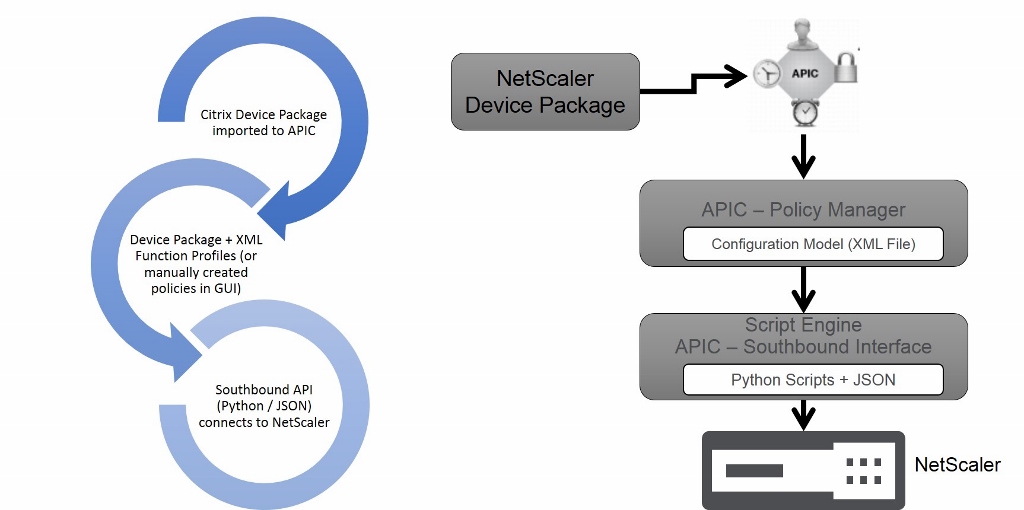
Citrix NetScaler and Cisco ACI: How it all Works

It’s an exciting week ahead at Cisco Live in San Diego.

Citrix is pleased to be a key Cisco ACI ecosystem partner through the integration of the Citrix NetScaler ADC with the Cisco APIC controller.

There are several interesting technologies being leveraged to deliver this joint solution and I thought would be interesting to take a look at how it is implemented. Cisco APIC addresses the two main requirements for achieving the application centric data center vision:

•Policy-based automation framework

•Policy-based service insertion technology

A policy-based automation framework enables the APIC to dynamically provision and configure resources according to application requirements.

As a result, core services such as firewalls and Layer 4 through 7 switches can be consumed by applications and made ready to use in a single automated step.

Being application-centric, the APIC allows the creation of application profiles, which define the Layer 4 through 7 services consumed by a given data center tenant application. As a key ADC partner in the ACI ecosystem, Citrix NetScaler provides L4-L7 services such as load balancing, application acceleration, and application security.

Cisco ACI and Citrix NetScaler ADC Solution


Figure 1. Cisco ACI and Citrix NetScaler ADC Solution

Tuesday, June 2, 2015

Citrix and Cisco Deliver Application Agility and a Path to Software Defined Networks

Applications are the core of any business. To respond quickly to changing business requirements, IT organizations must be able to deploy applications rapidly across a broad range of physical and virtual infrastructure while ensuring performance, scalability, security and visibility.

But applications are only as agile as the infrastructures on which they run.
With traditional datacenter infrastructure, it can take weeks to make an application change. Cloud, mobility and virtualization trends further complicate the interplay between applications, network services and the underlying infrastructure. Achieving a truly agile, application-driven datacenter requires a flexible infrastructure that can respond dynamically to application needs, automatically provisioning and configuring the necessary resources independent of their location.

Citrix and Cisco Systems have worked to accelerate the transformation to new network service delivery models that provide greater business agility. They deliver a robust set of capabilities--from product integration and validated designs to new technologies--that provide immediate benefits to customers while streamlining the transition to software-defined networks (SDN) and application-centric infrastructure.


Sunday, May 31, 2015

Cisco ACI and Citrix NetScaler Automate Services Provisioning and Increase Application Performance

With Cisco Live coming up in San Diego at Citrix we are ramping up to talk about NetScaler and the integration that we have done with Cisco Application Centric Architecture (ACI). The world’s leading enterprises, service providers, cloud computing platforms, and eight of the top ten internet-centric companies, have standardized on Citrix NetScaler to deliver their business-critical web applications. By integrating with Cisco ACI we are bringing the benefits of the top application delivery controller to the leading software defined network architecture and enabling our customers to automate NetScaler deployments.

Challenges with Application Delivery
As businesses look to IT as a point of strategic differentiation, agility in the datacenter becomes more critical than ever. Fundamental to this change is the capability of IT to respond quickly to changing business requirements. Applications serve as the core of any business, but applications are only as agile as the infrastructure on which they run. With yesterday’s datacenter infrastructure, this can mean waiting weeks for an application change. Application agility, mobility, and rapid deployment require the datacenter infrastructure to dynamically respond to application needs as a result of changing business requirements.


Saturday, January 31, 2015

A Look Back at 2014 and Innovation at Juniper Networks

As the year comes to an end it’s always interesting to look back at the changes in the industry and the progress that we made as a company in the last year. There were many trends that emerged or took further hold of the industry in 2014. Let’s take a look at them and see how Juniper delivered innovation in these areas. Cloud computing and the need for on-demand resources was a big one. The open source movement is continuing to grow in the cloud space and OpenStack and CloudStack are gaining momentum. The Dev/Ops movement and the need for automation of IT resources was another big trend in the news. We saw Dev/Ops extend to networking equipment like the top of rack switch, when it had previously been mainly for server configuration. Overlay networks took hold in 2014 with the likes of Juniper’s Contrail and VMware’s NSX gaining momentum. New network fabric architectures were introduced like IPClos that is popular with the MSDC’s or Massively Scalable Data Center Operators and Spine and Leaf architectures that offer simplified deployment and management. The rise of the Open Compute Project and its move to include networking was a bit of a surprise for me. There is certainly something going on there.

Openstack/Cloudstack Integration
Cloud computing is transforming the way business is done today. It’s not hard to see why when you consider all the benefits that the cloud promises such as flexibility, business agility and economies of scale. As you look into the underlying layers of compute, storage and network, there is complexity in managing such an infrastructure in a dynamic environment. Organizations that are building clouds need a platform to automate the deployment of infrastructure. In addition to offerings from commercial vendors this type of software stack is being developed by the user community of open source organizations. In the interests of being open and offering our customers choices Juniper announced support for OpenStack back in 2013. We continued this momentum by announcing support for CloudStack in 2014. For more on CloudStack see, CloudStack and Juniper’s MetaFabric, Enabling Private and Public Cloud.

Automation Integration with Puppet, Chef and Ansible
Juniper has always been about being open. We serve a diverse set of customers with different use cases who like to use different tool sets. Back in 2013 we announced support for Puppet. We kept up this momentum by later announcing support for Chef and then for Ansible in 2014. There are sysadmin using Puppet or Chef to manipulate infrastructure as code. Because we are open, we’ve productize the capability to work with these tools into both our hardware and software solutions. Ultimately this gives our customers greater flexibility, without having to do a costly rip and replace of their infrastructure, in choosing which automation tools to use. Of course Juniper has had on the box automation as a part of JUNOS for many years. For more on automation see, Automation with Chef, Puppet and Ansible.

Wednesday, September 10, 2014

Making the Transition to an Open SDN Architecture in the Enterprise Private Cloud

Enterprise IT is moving away from acting as siloed service organizations to aligning with the business’ goals to help their organizations enhance their business agility, value and customer experience. Many of these organizations are moving to a cloud computing model to achieve these goals, but they haven’t determined the best strategy for making this transition.
Transitioning to the cloud will help these organizations accelerate innovation and business agility by emphasizing a number of important factors.  Adaptability is one.  Seamless scale, both upward and downward, is another. Network intelligence that will provide proactive resource optimization is a third.

To make this transition, organizations need the right infrastructure, and they must be prepared to answer questions regarding SDN, orchestration, security, network protocols and many other issues.

These are addressed by two application-aware architectures for the enterprise private cloud:

1.    Juniper Networks’ open SDN architecture

2.    A proprietary programmable architecture that requires investment in a centralized controller and application-aware switch combination.

transition.png

Saturday, December 7, 2013

Optimizing EVPN for Virtual Machine Mobility over the WAN

Organizations need to insure that their applications are available and performing. Server virtualization helps by enabling virtual machine mobility.  If a server is overworked or will be unavailable vMotion can be used to migrate live workloads to another server in the current data center or in another data center. This requires that the addressing including the MAC, IP address and VLAN ID remain the same so that sessions are not dropped when the VM move happens. This is done by extending the L2 domain to the new location, know as Layer 2 stretch. Within a subnet this is easy to do. Across subnets in the data center it becomes more difficult. Doing live migration over the WAN introduces considerable challenges. Juniper has introduced a number of technologies to make virtual machine live migration possible.

The challenge with VM mobility is how to do the Layer 2 stretch in a way that ensures that the VM can be reached after it is moved. There are a number of issues that need to be dealt with. The MAC and IP address no longer pinned to a site or to an interface as they have moved with the VM. You need fast convergence of network paths as VM moves so that traffic will reach it quickly. You need ingress and egress traffic convergence and optimization to avoid having traffic go through the former default gateway after the VM has moved. You need learning of the effects of the live motion event and information distribution control so that the network isn’t impacted by signaling traffic. You need proper L2 & L3 interaction so that everything happens in a timely manner to ensure the best experience for the users of the applications that are affected by the VM move. VPLS has been the traditional methods of doing this, and now Juniper is supporting EVPN to provide enhancements to the solution.

Sunday, September 29, 2013

Choosing the Right Switch is Critical to your Transformation Project

If your organization is going through a data center transformation project you are probably looking at your options for switching infrastructure. As you design your network to support the move to virtualized compute infrastructure and the roll out of new application deployments the choice of switching infrastructure becomes a critical decision. One of the most versatile switching platforms on the market is Juniper’s QFX Series 10GbE/40GbE devices.  I’ve had the opportunity to talk with many of our customers about the projects that they are using the QFX switches for and why they chose it over the other options in the market. I’d like to share these examples with you.

Many organizations are undergoing data center transformation projects such as moving to a virtualized data center, deploying large scale Enterprise applications, converging data and SAN networks, and undertaking big data analytics projects. They are looking for a versatile switching platform that they can deploy in any of these scenarios. The QFX switches are high-performance, low-latency, 1RU edge devices that are installed at the top-of-rack in the data center. They include rich Layer 2 and Layer 3 support and standards-based bridging, routing and FCoE capabilities. They can be deployed as standalone switches and then as the deployments increase in scale they can be converted to a QFabric node through a simple software upgrade. This makes them ideal for these types of projects.

Monday, September 23, 2013

Simplifying the Network is the Key to Improving Application Performance

In order ensure application performance and increase productivity across the organization while trying to keep budgets under control Enterprise organizations have been increasingly evaluating and implementing a series of new technologies for the past few years. These technologies hold out the promise of increasing the agility of new application rollouts that deliver game changing services, and meeting the needs of the organization to understand the business and make timely and well informed decisions as well as meeting the changing needs of the organization as they adapt to moves, consolidations and mergers.

The first one of these technologies is server virtualization which is now reaching the middle of the bell curve of the adoption cycle with more than half of organizations at the pervasive or fully virtualized stage according to IDG. The next is cloud computing where investments are up over last year, and the year before, with private cloud now as the preferred model over public cloud. Lowering TCO is a top selling point for both private & public cloud. Cloud solves challenges around business continuity and disaster recovery by providing resources on demand, often in a pay as you go model. It also becomes more popular as organizations begin to see it as an alternative to large capital expenditures for infrastructure.

Wednesday, October 17, 2012

Have We Hit The Network Breaking Point?

We have all noticed that the business environment is changing at a rapid pace. IT departments, previously seen as cost centers, were tasked with reducing their infrastructure and even justifying their existence, but not anymore. With the rise of just-in-time manufacturing, and long tail customization, all driven by ecommerce that’s increasingly accessed from mobile devices, the old rules are being turned upside down.  The IT organization is now tasked with enabling the business to drive innovation.

The Opportunity that Comes with Change
While change comes with opportunity, we know change isn’t always easy. The old ways of building infrastructure and networks are no longer working. Organizations need to adapt to a world where customers use social media and create huge amounts of data that contains business intelligence.  All of us have questions about what is happening in the IT space, what the challenges are and what do to about it. That is why Juniper got together with Forrester and did some research to help sort this all out.

It started in July 2012, when Juniper Networks commissioned Forrester Consulting to evaluate what enterprises need from a network in order to scale for business and meet future needs. Forrester Consulting surveyed 150 IT business decision-makers from enterprises across the United States, and yesterday the results were shared in a webinar. It was a conversation between Forrester Analyst Andre Kindness, Juniper’s CIO Bask Iyer and Mark Settle from BMC Software. I listened in and there was a lot to learn. 

Sunday, August 26, 2012

Is VXLAN the Answer to the Network Virtualization Question?

Network virtualization is a growing topic of interest and for some good reasons as networks scale to meet the challenges of cloud computing they are running up against VLAN scaling limitations. There have been several network overlay technologies released that seek to address the challenges with network scaling and to enable workload mobility. One of these technologies is VXLAN. It has a few proponents who say that it can meet the requirements for network virtualization. While it sounds good on the surface, it is worth it to take a closer look. With VMWorld happening this week in San Francisco I’m sure that network virtualization will be a hot topic, especially considering the VMware Nicera news, so I thought I’d comment on it and offer some thoughts and options.

The Origins of VXLAN
The VXLAN buzz started during a keynote at VMworld in August 2011, when VMware CTO Steve Herrod announced the Virtual eXtensible LAN protocol, which VMware positions as a technology that “enables multi-tenant networks at scale, as the first step towards logical, software-based networks that can be created on-demand, enabling  enterprises to leverage capacity wherever it’s available. Networking vendors Cisco and Arista are actively promoting VXLAN and have collaborated with VMware to develop and test the technology on their products. Cisco highlighted VXLAN at their Cisco Live user conference again in June 2012 and Arista is demoing it at VMWorld, however with the Nicira announcement VMWare seems to have taken that next step. VXLAN sounds interesting, so let's see how good of an idea it is.

Sunday, July 22, 2012

Is There a Real Use Case for LISP, The Locator/ID Separation Protocol?

LISP is a protocol that pops back in the news just when you might have forgot that it existed. It happened again in June when Cisco re-launched LISP for fast mobility at their annual user conference, complete with an on stage demo and much fanfare. While the demo’s are impressive, the history of LISP makes me wonder what is going on behind the curtain. This isn’t the first time that Cisco has proposed LISP for a new use case. In 2011, Cisco positioned LISP as a solution for IPv6 transition and virtual machine mobility, along with VXLAN and OTV, creating a triumvirate of proprietary protocols to further pioneering use cases. But is there real value in LISP?

What is LISP? 
LISP is a protocol and an addressing architecture originally discussed at the IETF in 2006 to help contain the growth of the route tables in core routers. The LISP proposal which was submitted in 2010 is still under development as an experimental draft in the IETF, see link.  As far as I have see there is not much consensus regarding the usefulness of LISP, and it has several open issues in the areas of security, service migration and deployability. Because the cost and risk associated with LISP are significant, network operators have scaled their routing systems using other techniques such as by deploying routers with sufficient FIB capacity, and by deploying NAT.

Tuesday, August 30, 2011

The VCE Vblock FastPath Desktop Virtualization Platform

Organizations face increasing costs and security concerns created by the quantity and diversity of devices accessing the network, but they must still respond to the growing needs of the business. Now organizations can rapidly deploy a more secure, cost effective and flexible desktop environment using the Vblock FastPath Desktop Virtualization Platform. See this video to learn how the you can deploy virtual desktops faster.


The Vblock FastPath Desktop Virtualization Platform is a purpose-built solution that helps IT organizations to automate desktop and application management by enabling rapid deployment, reducing costs and improving security through centralization of the desktop environment.

Backstory: I wrote the script for this video and worked with the producer to get it completed. It was done for the launch of the FastPath solution for which I was the marketing manager.

Sunday, August 28, 2011

Solving The Desktop Virtualization Challenge With Vblock FastPath

The Desktop Challenge
The traditional workplace experience used to be working at the office on a PC. Now, the workplace could be the office, the home, or any public location. Now we have more than PC's. Work tools also include tablets and smart phones. Network users could be anywhere, on any kind of device, and they'll need access to all forms of rich media like real time interactive video as well as voice. As a result of these changes organizations are faced with growing security concerns around access to applications and control over corporate data.

Virtualization has been used extensively over the last decade to consolidate servers, improve resource utilization, reduce power consumption, lower costs, and streamline server management. Many of the same issues around cost, complexity, and energy efficiency impact desktop users and IT administrators. Conventional desktop computing approaches are evolving to address an increasing number of regulatory requirements such as Sarbanes-Oxley, and HIPAA. We all know that data breeches are a major concern for corporations. Organizations are trying to protect data, and to simplify desktop management , while meeting the needs of users who demand greater mobility, more devices, and increased flexibility.

As a result of these challenges with desktop management organizations are looking for ways to deploy a more secure, cost effective and flexible desktop environment using Virtual Desktop Infrastructure. With VDI organizations can centrally manage desktop images, ensuring a uniform experience for users no matter what platform they are using or where they are locates. With VDI company wide security posture is improved by keeping critical information in the corporate data center, not on the PC. Costs are reduced through centralized desktop management.

Tuesday, August 16, 2011

The Vblock Trusted Multi-Tenancy Model for Cloud Services

Cloud computing offers many economic and environmental advantages to service providers. The ability to deliver infrastructure services to multiple internal or external consumers is a core component of cloud computing. With shared virtual converged infrastructure and best-of-class network, compute, storage, virtualization, and security technologies from Cisco, EMC,and VMware, the Vblock platform presents new opportunities for service providers to deliver secure dedicated services to multiple tenants. In this video you will learn how Vblock Trusted Multi-Tenancy (TMT) from VCE enables service providers to address the key concerns of tenants in the multi-tenant environment – confidentiality, security, compliance, service levels, availability, data protection, and management control.


Backstory: I wrote the script for this Flash video and worked with the producer to get it created.

Friday, August 5, 2011

Vblock: Accelerating the Journey to Private Cloud

In the continuing quest for a fully virtualized data center, IT professionals have a new tool that promises to dramatically simplify the journey: the Vblock. This 60-minute TechWiseTV episode explores this latest advancement in unified computing and shows how it will make it easier for organizations to build out data centers.


You will learn how Vblock™ Infrastructure Platforms simplify the acquisition and deployment process by integrating best of breed technology from Cisco, EMC and VMware into prepackaged units of infrastructure that are optimized for a wide range of virtualized solution deployments and how since each Vblock is pre-built and ready for deployment and the modular design is highly scalable to meet growth needs, your projects will get completed faster and you will have investment protection, and lower total cost of ownership.

Backstory: This video was created by TechWiseTV, a team at Cisco and features my collegues from VCE. I used social media including the Cisco Data Center blog, Twitter, Linkedin and Facebook to promote it and increase the views many fold. While at Cisco I created the Cisco Cloud Facebook page and managed the Cisco Cloud Linkedin Group. This also appeared on the Cisco Data Center blog site.

Thursday, July 21, 2011

The Vblock Solution For Cisco Unified Communications

To succeed in today’s fast paced, global economy, businesses must be able to communicate and collaborate. This requires access to a range of voice, video, and messaging communication tools. While the essence of communication is to break down barriers, organizations today must contend with the barriers imposed by increasingly complex communications environments.

The VCE solution enables rapid deployment of Cisco® Unified Communications applications on Vblock™ Infrastructure Platforms to provide an integrated hardware and software solution that connects people, information, and teams, helping to enable comprehensive and effective collaborative experiences.

Watch the video “Cisco UC ‘As-A-Service’ Offers on Vblock Platform” which provides an overview of the solution, and what customers can expect and then read more to get the details on the solution.


Read more to get the details on the solution.

Wednesday, July 13, 2011

The Vblock Solution for Cisco Hosted Collaboration

The Market Challenge
Hosted Collaboration is a growing opportunity for Service Providers to expand their portfolio and meet customer needs. Cisco provides Unified Communications applications using the Cisco Hosted Collaboration Solution (HCS) that enables service providers to deliver a range of services from IP telephony and voicemail to WebEx® conferencing. One of the biggest challenges facing service providers is getting services to market and meeting time to revenue goals. Revenue opportunities are missed when time is lost reviewing product specifications, testing configurations and determining the appropriate scale for a particular application.

The Vblock Advantage
The Vblock™ Infrastructure Platforms solution for Hosted Collaboration makes Cisco® Unified Communications and Collaboration applications and capabilities available in a hosted environment. Vblock™ platforms provide standardized units of best-of-breed IT infrastructure that can be managed as a single entity and easily scaled as a cohesive, multi-tenant system. With the Vblock solution service providers can bring hosted collaboration service to market rapidly and meet their time to revenue goals.

Video: Cisco HCS "As-A-Service" Offers on Vblock Platform

Thursday, March 3, 2011

Cloud Services are a Bright Option for the Enterprise

The Cloud Opportunity
With Cisco Partner Summit happening in New Orleans this week there has been a lot of important news with the announcement of the Cloud Partner Program that enables and encourages Cisco Partners to develop and deliver cloud services being at the top of the list. You can follow the action on the Cisco Channels Facebook page. This announcement might have you wondering what the size of the market for cloud services is and what Enterprise organizations are thinking as they consider the move to services from the cloud.

At Cisco we had these same questions as we were making investment decisions in the systems and solutions that enable organizations to build a cloud service delivery architecture. As a result the Cisco® Internet Business Solutions Group (IBSG) conducted research that included interviews with enterprise IT decisions makers and key subject matter experts. The study showed that enterprises across many sectors are seriously considering cloud computing. Based on direct feedback from enterprise decision makers, Cisco IBSG estimates that close to 12 percent of enterprise workloads will run in the cloud by the end of 2013 and that this will yield a market for public-cloud services of approximately US$43 billion. Organizations have a few things to consider as they make this migration to the cloud.

To Cloud or Not To Cloud
The primary reason for the enterprise to adopt cloud services is to reduce costs and increase agility. The decision to migrate to the cloud hinges the how access to critical applications will be impacted and what the benefits are for running applications in the cloud when weighted against the constraints. Many factors come into account such as workload variability, the need for agility, and application functionality when run in the cloud. The applications that are most suitable for delivery from the cloud are workloads with variable or unpredictable resource requirements. For example workloads that are seasonal, such as tax season, or public-facing applications such as online sales. Since these applications must be provisioned for peak loads there is a major cost advantage to utilizing on-demand infrastructure to run them. Applications that require quick setup, such as sales-and-marketing campaigns, and application development are prime candidates to move to the cloud as well.

Sunday, February 20, 2011

The Benefits of a Virtualized Approach to Advanced-Level Network Services

Advanced-Level Services
Advanced-level network services are a necessity for a scalable virtualized data center and a key to cloud service delivery. These services provide application acceleration and server load balancing to improve user productivity, and ensure optimal resource utilization, and they monitor quality of service. They also provide security services that can isolate applications and resources in logical zones in virtualized data centers and cloud environments to ensure regulatory compliance and reduce risk of data breaches.

Deploying Services
While enterprises have been adopting server virtualization and cloud computing in order to realize the benefits of reduced server sprawl, reduced operating costs, and greater levels of application availability, they are doing so while struggling with inflexibility in the underlying network. Deploying advanced-level network services in a virtualized data center environment is challenging. It has been done using dedicated hardware in static network topologies. This does not provide the flexibility to support virtualized workloads, and as a result organizations are challenged to support on-demand virtual machine (VM) provisioning, workload mobility, and public or private cloud deployments. This limits organizations' ability to efficiently deploy new applications, increases operational costs, and acts as a roadblock to adoption of virtualization and cloud computing.

The Solution
While enterprises have been adopting server virtualization and cloud computing in order to realize the benefits of reduced server sprawl, reduced operating costs, and greater levels of application availability, they are doing so while struggling with inflexibility in the underlying network.The solution is to implement virtualized advanced-level network services that run as software on a compete platform. Such virtualized services can provide the same features and functionality as appliances, but in a more scalable, unified, and cost-effective manner. A complete solution needs to provide visibility and support for the virtual applications and allow for application mobility and on-demand capacity expansion. IT organizations have been pushed in to taking a piecemeal approach to adding these services by cobbling together solutions using point-products, and deploying physical appliances in each data center. This is because a virtualized network services solution that implements services in a standardized, holistic way has not been available.